FIFA WORLD CUP 2026 – WHY IT COULD BE THE MOST COMPETITIVE EDITION OF FOOTBALL’S ELITE TOURNAMENT

Football is generally an exciting game, and the FIFA World Cup feels even more exciting as it brings the entire world to the round-leather game.
Every edition of the FIFA World Cup sparks thrilling scenarios, incredible moments, and plenty of excitement. Croatia blew our minds by reaching the final of the 2018 World Cup, while Morocco did the unthinkable by reaching the semi-finals of the 2022 edition, becoming the first African country to achieve this milestone.
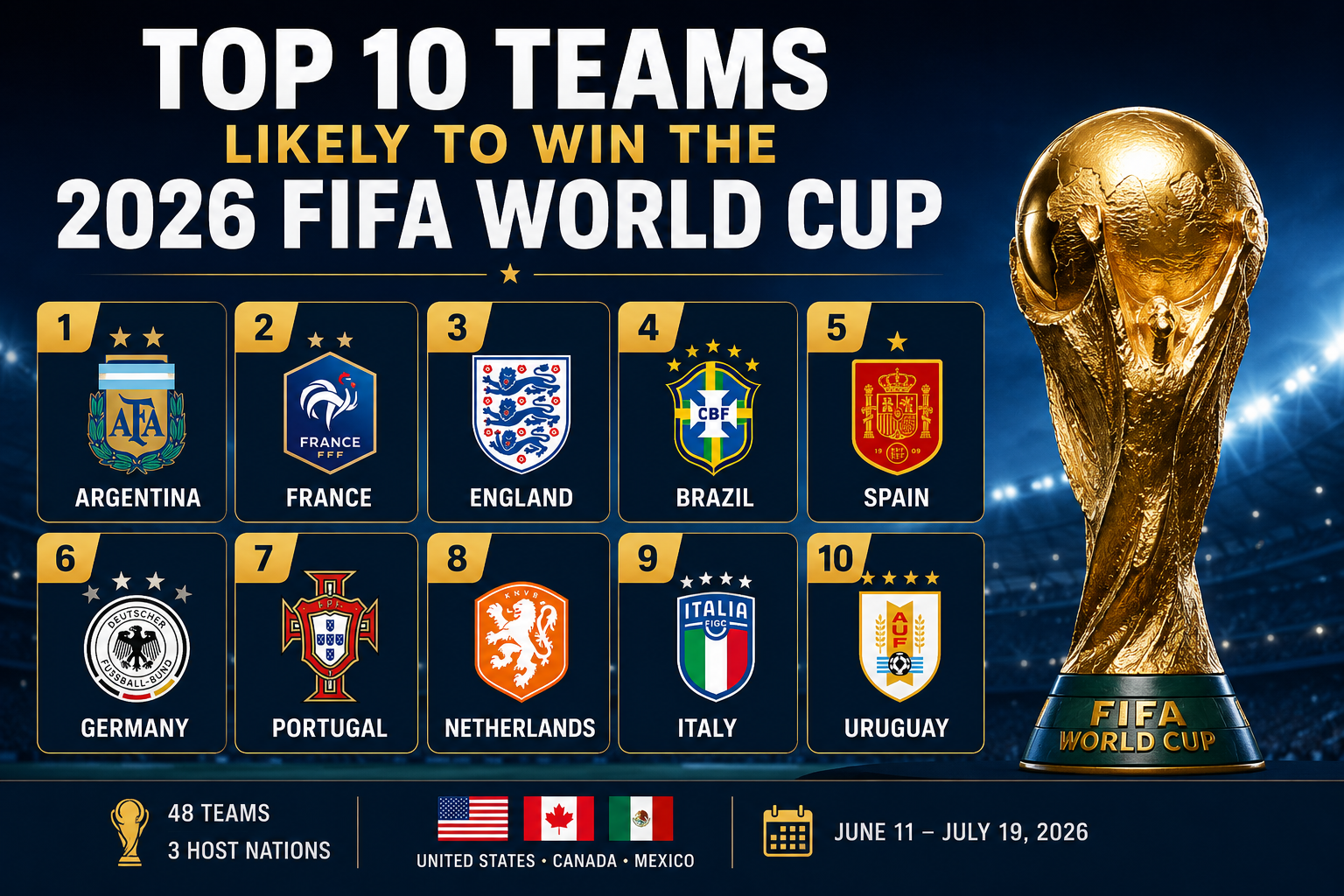
The 2026 FIFA World Cup has been predicted to spark a new level of drama. In the history of football, this is the first time as many as 48 teams will be competing for the game’s most-coveted trophy.
As many analysts believe the 2026 edition will bring a level of competition that we never saw in previous editions of the tournament, we’re tempted to reel out some of the reasons why it could be the most competitive FIFA World Cup ever.
Underdogs Keep Pulling Surprises
Those who have followed the FIFA World Cup for the past two decades will likely agree that the contest seems more balanced. Many underdogs have demonstrated that they are no longer pushovers. Unlike a past era when only Brazil, Italy, Argentina and Germany could easily come up in the discussion of favourites, several more teams have proven their worth.
Frankly, we now have a more competitive favourites’ list comprising other heavyweights like France, Spain, and England. Moreover, countries like Portugal and Netherlands are approaching the 2026 FIFA World Cup with squads that could stand up to the ones at the disposal of Brazil, Argentina, and even other traditional favourites.
The New Format Appears More Competitive
2026 FIFA World Cup is the first to feature a 48-team format. This isn’t only a significant extension of the previous 32-team format, but also a recipe for more competition.
We believe the new format should bring about more competition because teams know they must gear up for more matches. And right from the group stage, coaches know they need to figure out the appropriate tactics for staying strong in the contest.
As traditional favourites and other heavyweights will want to stay top of their respective groups, they definitely need to put their best foot forward. Thanks to the 48-team format, the competition will likely witness new tactical approaches and more dynamic playing styles.
The Group Stage Could Be More Dramatic Than Ever
Unlike previous editions of the tournament, the 2026 FIFA World Cup will have more teams trying to qualify from the group stage. There’s no denying that surprises will spring up here and there; certain teams in pole position to qualify might suddenly lose out as a result of happenings in other matches.
Plenty of football fans following the group-stage action will likely anticipate late dramas, incredible moments, and red-hot matches. As the action progresses, different teams will try to figure out what’s right for them such as maintaining a high-defense approach (perhaps to secure the lone point needed to qualify) or attacking massively with the hope of scoring enough goals.
Teams with Squad Depth Could Have an Edge
At the FIFA World Cup 2026, there’s going to be a longer haul of matches. Coaches know they have to prepare their squads for an extended realm of contest.
While suspensions and injuries may shape the dynamics half-way through the contest, we believe that teams with the best squad depths will still stand top. Just like injuries and suspensions, fatigue is a key factor that could weigh down a high-flying team.
Nevertheless, and especially in the knockout stages, teams with great squad depths could benefit massively; they could replace their weak legs with quality substitutes.
There Could Be Increased Urge to Wager on Matches
Many football punters have followed the FIFA World Cup well enough to have a great idea of who the traditional favourites are. These punters might want to place outright wagers on the team to emerge as the winner of the tournament.
But for a different category of punters who’d keenly follow the 2026 FIFA World Cup, the much-anticipated competitiveness could encourage them to choose betting markets such as BTTS, Over 1.5 Goals, and Over 2.5 Goals, among others. Whether these are the exact markets you’d like to choose when wagering on 2026 FIFA World Cup matches or you won’t mind picking various other betting markets, rest assured that Acepredict has the best football tips for you.
At Acepredict, there exist tons of football predictions across multiple popular and lesser-chosen markets. Acepredict’s 2026 FIFA World Cup predictions will be enough to boost your chances of success in football betting.
The prediction algorithm employed by Acepredict has been designed to not only identify changes in momentum, but also leverage squad depth, player availability, goal-scoring form, and other key factors in making excellent football forecasts.
Football Tactics Seem More Refined
Football is a dynamic game where new styles, tactics and approaches come to the fore. Coaches are well aware of this and while they are in fact the inventors of these new tactics, some coaches might consider the 2026 World Cup the suitable avenue for implementing new styles.
Coaches who appear rather more dynamic could switch tactics depending on the opponents they’re about to face. These coaches perhaps know that no matter how effective it seems on paper, a particular game plan might not fit certain occasions.
Squad depth, dominant playing style and reputable history (probably as one of the traditional favourites) may appear significant. But because they aren’t the only factors that could steer a team’s ship at the FIFA World Cup, coaches know they must incorporate the right strategy.
Coaches at the 2026 FIFA World Cup will likely look into advanced football stats and in-depth analysis of matches. Generally, football has become a more tactical game and every coach at the new-look FIFA World Cup will try to get more tactically refined.
The Massive Global Reach Could Inspire More Competitiveness
We have stressed that the new-look 2026 FIFA World Cup –especially for its 48-team format –could appear more competitive than the previous editions of the tournament.
The anticipated massive global appeal is suggested to be another reason why 2026 FIFA World Cup could become the most competitive edition of football’s biggest tournament. It’s been widely predicted that the 2026 World Cup will attract a mind-blowing audience, thanks to the scheduled hosting in notable stadiums across the United States, Canada, and Mexico.
While a staggering number of international fans will be in the stands, there’s bound to be pressure –the irresistible urge to impress the massive audience. Football is nonetheless a pressure-oriented game and it’s worth anticipating that some teams would crumble under pressure while several others could stand firm regardless.
At the 2026 FIFA World Cup, the resilience of various teams will be tested in front of a massive global audience. While several underdogs might be hellbent on clinching “statement” victories, this could inspire a level of competitiveness we’ve never seen at the FIFA World Cup.
Final Thoughts
So far, we’ve shared our thoughts on why the 2026 FIFA World Cup could be the most competitive edition of football’s biggest tournament. While the new 48-team format is expected to create fierce competition, the other thoughts we shared are enough to convince football lovers that 2026 could present us with the most competitive edition of the FIFA World Cup.